Luyang Zhang: Regarding the Validity of China’s Strategy of Constructing an Innovation-driven Nation Through the Lens of This Year’s Nobel Prize in Economics | Insights
Release time:2025-10-20
[Drive the innovation and entrepreneurship of digital technology and create digital industries; drive digital technology and digital industries to empower agriculture digitization (intelligentization) and industry digitization (intelligentization), being the key to realizing overall innovation and entrepreneurship and constructing an innovation-driven nation]

Luyang Zhang
Professor in Finance at Fudan International School of Finance (teaching track)
Director of China Venture Capital Research Institute, Fudan University, Director of Modern Corporate Governance Research Center, Fudan University
He serves as an expert member of Corporate Governance Committee of Shanghai Stock Exchange, while concurrently serving as the vice president of Modern Finance Society, the vice president of China Entrepreneurship Investment Association, a special expert of the Innovation & Entrepreneurship Education Alliance of China, Ministry of Education, the vice chairman of Fudan University Alumni Association, the executive president of Fudan University Postdoctoral Alumni Association, and etc. Meanwhile, he also takes the post of a postdoctoral supervisor for financial institutions such as Shanghai Pudong Development Bank, Shanghai Stock Exchange, Bank of Communications, Shenwan Securities, Guotai Jun’an, Guangdong Yuecai Group, and Suzhou Guofa Group.
This year, the Nobel Prize in Economics was awarded to three economists, namely Joel Mokyr, Philippe Aghion and Peter Howitt. Drawing on centuries of historical data and deriving relevant theoretical models, their research findings have unraveled the mechanism by which technological progress and creative destruction drive sustained economic growth and presented the conclusion that innovation-driven growth depends not only on the accumulation of knowledge but, more critically, on institutional openness.
In the first place, from perspectives from macro to micro, the three economists’ research has largely enriched Schumpeter's theory of innovation and Stiglitz's economics of innovation. In the angle of sustained technological innovation, they expounded the reasons why economies remained trapped in the "Malthusian trap" for extended periods and filled the gap in micro-level firm mechanisms within the early Solow Model and later Romer Model concerning economic growth. Secondly, theoretical support for technology-driven innovation was brought about to address the issue of how to realize economic growth amid the current climate of global economic uncertainty. Thirdly, they also developed new quality productive forces through “AI+” and highlighted the necessity of institutional innovation based on the digital technology revolution.
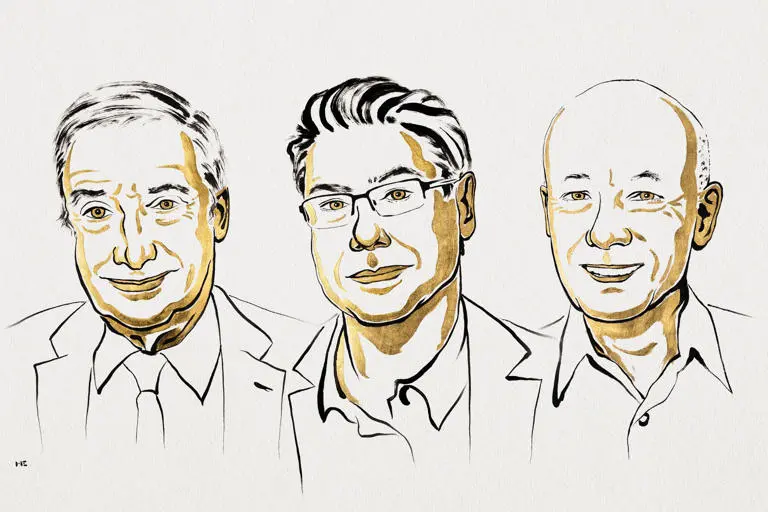
▆ 2025 Nobel laureates in economics
The three economists’ researching findings provided a robust explanation for the validity of China’s development strategy of constructing an innovation-driven nation by 2035.
In Part V of the Report to the 19th National Congress of the Communist Party of China, General Secretary Xi Jinping lays emphasis on a series of keywords such as “innovation-driven nation”, “entrepreneurship”, “innovation and entrepreneurship”, “business regulatory system” and “multi-tiered capital market”, which altogether compose the macro-system mechanism for the operation of the “New Economic Era” framework. Practically, the stress on these words outlines definitive strategic goals and actionable implementation routes for driving innovation through the “technology-industry-economy (finance)” nexus.
Based on the principle of innovation-driven economic growth, a modern innovation-driven nation encompasses three macro-level systems:
01
Firstly, the innovation-driven economic development of existing enterprises
02
Secondly, the new economy created by emerging technology-based startups
03
Thirdly, the national fiscal policy system for supporting innovation and sci-tech finance system for supporting entrepreneurship
These three systems drive the innovation and entrepreneurship of digital technology and create digital industries; drive digital technology and digital industries to empower agriculture digitization (intelligentization) and industry digitization (intelligentization), working together towards the goal of realizing comprehensive innovation and entrepreneurship and constructing an innovation-driven nation.
Centering on the three systems, the micro-level innovation and entrepreneurship mechanism comprises four chains that form the underlying environment.
01
Firstly, the process from research and development to technological innovation and entrepreneurship forms a multi-stage chain comprising seed, startup, growth, and maturity phases, known as the "Science and Technology Innovation Chain" (STI Chain);
02
Secondly, investment targeted at the “STI Chain” constitutes a technology investment chain comprising R&D investment, angel investment, venture capital, and private equity investment, known as the "Science and Technology Finance Chain" (STF Chain);
03
Thirdly, government policies supporting scientific and technological innovation and entrepreneurship form a policy chain comprising policies for R&D support, technology transfer encouragement and innovation-entrepreneurship promotion, known as the "Science and Technology Policy Chain" (STP Chain);
04
Fourth, a service chain is formed to mitigate significant uncertainties, enhance the efficiency of scientific and technological innovation and entrepreneurship and provide value-added services tailored to each stage of this process, known as the "Science and Technology Service Chain" (STS Chain).
At the 2023 Central Financial Work Conference, the act of “leveraging financial innovation to better serve scientific and technological innovation” was emphasized. By establishing the “STP Chain” as the policy environment, forging the “STF Chain” as the financial engine, and utilizing the “STS Chain” to add value to the “STI Chain”, and based on the new quality productive forces brought by digital technology, in combination with the tremendous achievements of China’s economic reform and opening-up, we can promote high-quality economic development, advance the strategy of constructing an innovation-driven nation, and realize Chinese-style modernization, which fully align with the requirements of technological innovation patterns in the new era.





 86-21-63895588
 Handan Campus: Building B, No.579 Guoquan Road, Yangpu District, Shanghai 200010