[Live Review] AI and Molecular Science Research: Enlightenment for Education Models, Career Planning and Industrial Development | Fudan Financial Public Course
Release time:2026-04-09
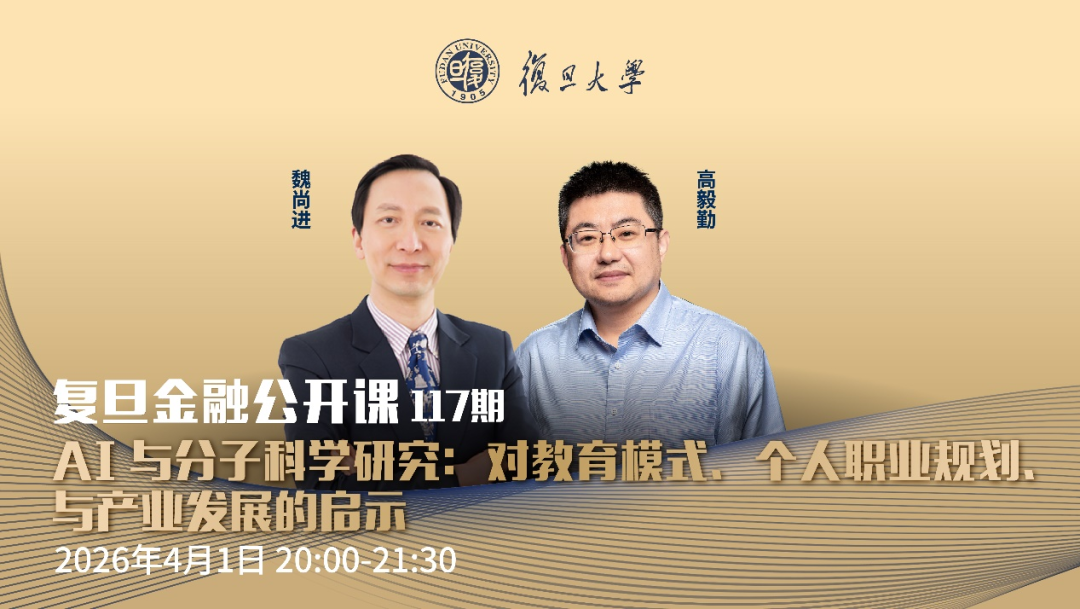
Fudan Financial Public Course Session 117
AI and Molecular Science Research: Enlightenment for Education Models, Career Planning and Industrial Development
April 1st 2026 20:00-21:30
On the evening of April 1st 2026, the 117th session of the Fudan Financial Public Course was held online. Under the theme of “AI and Molecular Science Research: Enlightenment for Education Models, Career Planning and Industrial Development”, it focused on the cutting-edge intersection of artificial intelligence and molecular science and explored the far-reaching influence of technological transformation on research paradigms, talent cultivation and industrial upgrading. Shang-Jin Wei, Editor-in-Chief of Fudan Financial Review and Tenured Chair Professor at the School of Business and School of International and Public Affairs, Columbia University, acted as the moderator; and Yiqin Gao, Professor at Peking University, Deputy Director of the Peking University Division of Sciences, and New Cornerstone Investigator.
Moderator
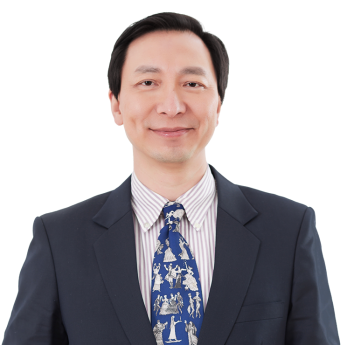
▲Shang-Jin Wei
Editor-in-Chief of Fudan Financial Review
Tenured Chair Professor at the School of Business and School of International and Public Affairs, Columbia University
Keynote Speaker
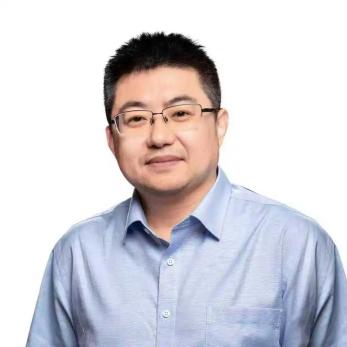
▲ Yiqin Gao
Professor at Peking University, Deputy Director of the Peking University Division of Sciences
New Cornerstone Investigator
When AI meets the molecular world
Yiqin Gao began by highlighting the importance of molecular science. He pointed out that molecules are essential to nearly every aspect of human life—from chemical materials, synthetic ammonia, pesticides to pharmaceuticals. We ourselves are complex living organisms composed of countless molecules. So, understanding the behavior of molecules at the atomic and electronic levels is crucial for understanding life and combating disease. However, the molecular world is extremely vast: the number of possible small molecules alone is estimated at 10 to the power of 200, far exceeding the total number of atoms in the universe, posing enormous challenges for traditional computational methods: quantum mechanics approaches can take months or even years to calculate a single small molecule, while molecular dynamics, though relatively more efficient, still struggle with large-scale, multiscale complex systems.
It was the advent of AI that opened up a new path to overcome the dilemma. Gao reviewed the technological evolution from AlphaGo to ChatGPT, with a special focus on breakthroughs in applying AI to molecular science. In 2021, DeepMind’s AlphaFold2 demonstrated the ability to predict three-dimensional structures from protein sequences in seconds, with accuracy comparable to experimental methods, greatly accelerating drug discovery. Since then, AI applications have rapidly expanded to small-molecule drug design, antibody engineering, and antimicrobial peptide development.
On this basis, Gao further shared the explorations of his research team in molecular representation learning, on-demand generation, and cross-scale modeling. By compressing molecular information into simplified, “barcode-like” representations, AI enables a “dictionary-lookup” approach to molecular property calculation and interaction; based on generative models, AI can generate small-molecule or protein sequences that meet specific requirements in a very short time; and through integrated coarse-grained experimental data (such as chemical cross-linking information), AI can present protein complex structures that more closely resemble those found in real cellular environments.
Furthermore, AI is advancing multiscale modeling from the molecular to the cellular level. Using one-dimensional DNA sequences and cell-specific epigenetic information, Gao’s team has successfully predicted the three-dimensional folding structure of DNA within the cell nucleus, as well as gene expression states. This provides a new computational tool for understanding cell differentiation and disease mechanisms.
With the emergence of various AI models and scientific computing software, a practical question arises: how can researchers efficiently navigate and utilize these increasingly complex tools? Gao introduced ADAM, a scientific agent being developed by his team. Capable of understanding research needs through natural language conversation, ADAM can automatically invoke a variety of software and computing resources, executing complete workflows—from modeling and computation to result analysis. He also showed the audience examples of high school students using this platform to conduct research that would typically require doctoral-level training.
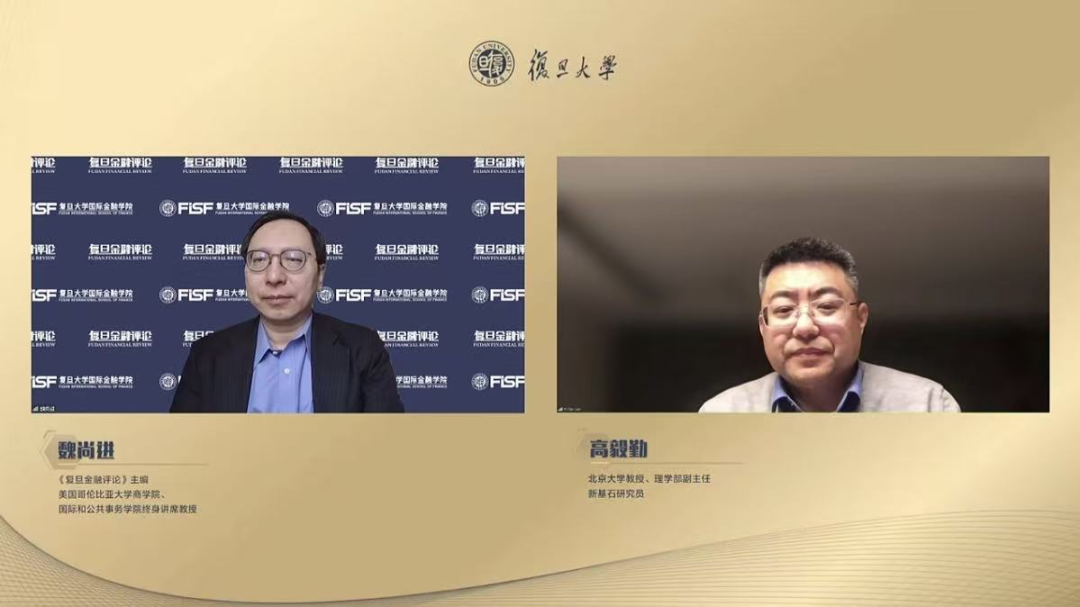
At the dialogue session, Shang-Jin Wei and Yiqin Gao had an in-depth discussion on educational transformation, industrial impact and career planning in the age of AI.
Regarding the impact of AI on research disparities between countries, Yiqin Gao held that it could both widen and narrow the gap. Countries with access to the best data and the strongest computing power hold the advantage. However, open-source models (such as some large language models in China) also provide equal opportunities for anyone with bold ideas. Currently, China and the U.S. are the most active players in AI-driven scientific research. Yet Europe and Japan also have strong roots in foundational algorithms and theoretical research, suggesting that new breakthroughs could still emerge from these regions in the future.
On AI’s impact on traditional industries and spawning of emerging industries, Gao noted that fields such as scientific computing and bioinformatics analysis may be the first to feel the change. In the past, cultivating a researcher proficient with specialized software took one or two years, but with AI, the scarcity of that skill set is now declining. Meanwhile, in medical sequencing and other relevant areas that have accumulated vast amounts of data yet to be deeply analyzed, AI has the potential to bridge the gap between “data bottlenecks” and “computing bottlenecks”, significantly improving industrial efficiency. Industries such as chemicals and materials will also see a transformation in their R&D models. Once a new material could provide a competitive advantage for many years, while in the future, rapid iteration will become the norm, pushing production processes to become more modular and customized. This shift will also give rise to more specialized and segmented new industries.
When it came to career preparation for young people in the age of AI, Gao advised that purely technical skills and rote memorization may matter less, while a solid understanding of fundamental principles (such as mathematics, physics and humanities) will matter more. As human-AI interaction becomes increasingly natural, the ability to communicate with real people becomes more precious. It is precisely human emotions and imperfect logic that drive human evolution and creativity. He also emphasized that young students should actively build human connections. Withdrawing from human interaction is not a wise path.

On whether AI could shorten the total number of years spent in formal education, Shang-Jin Wei raised a question from the audience: if AI significantly improves learning efficiency, could it compress the educational timeline from primary school through a PhD, thereby expanding the working-age population and boosting economic growth? Yiqin Gao acknowledged that the number of years in formal education could indeed be shortened, but on the other hand stressed that schooling also serves important social purposes, providing necessary time for people to grow. More importantly, AI enhances the efficiency of resource recycling and reuse, allowing each individual to generate greater value—without necessarily relying on a larger workforce. Meanwhile, he mentioned that it is a deeper issue of social distribution to involve people not participating in the labor force in progress sharing. From this perspective, extending the years of learning and promoting lifelong education—allowing people to find meaning in life through continuous growth—can itself be seen as a form of “intellectual GDP”.

At the conclusion of the course, Shang-Jin Wei remarked that Professor Gao’s easy-to-understand illustrations had not only revealed how AI is reshaping scientific research from the molecular level but also inspired the audience to reflect on the deeper implications of technological change for education, careers and human development. He thanked Gao for his insights and encouraged the audience to stay tuned for more future sessions of Fudan Financial Public Courses.
Fudan Financial Public Course
A high-end, free online course on finance and economics launched by Fudan International School of Finance in 2020. Focusing on cutting-edge issues in finance and economy, the course features distinguished guest speakers from both at home and abroad to offer insightful discussions on global transformations and a systematic diagnosis of China’s development trajectory. Designed to break down the traditional barriers of higher education, it explores an inclusive path for elite financial education, allowing more people to access financial knowledge and appreciate its true value.
For more details, follow our official WeChat public account and video channel: “Fudan International School of Finance”. Subscribe to our WeChat mini-program “Online Financial Education of Fudan University” to unlock more exciting courses.

Scan the QR code to watch videos and live broadcasts
Scan the QR code to subscribe to Online Financial Education of Fudan University





 86-21-63895588
 Handan Campus: Building B, No.579 Guoquan Road, Yangpu District, Shanghai 200010