Learning to Make Choices and Achieve Self-development! Here Comes the Full Text of Fudan University President Li Jin’s Speech at the 2025 School Opening Ceremony! | Heavyweight
Release time:2025-09-04
Today (on September 4th) at the 2025 school opening ceremony of Fudan University, Li Jin, President and Academician of CAS, gave a speech entitled Learning to Make Choices and Achieve Self-development, delivering wishes to all the freshman.
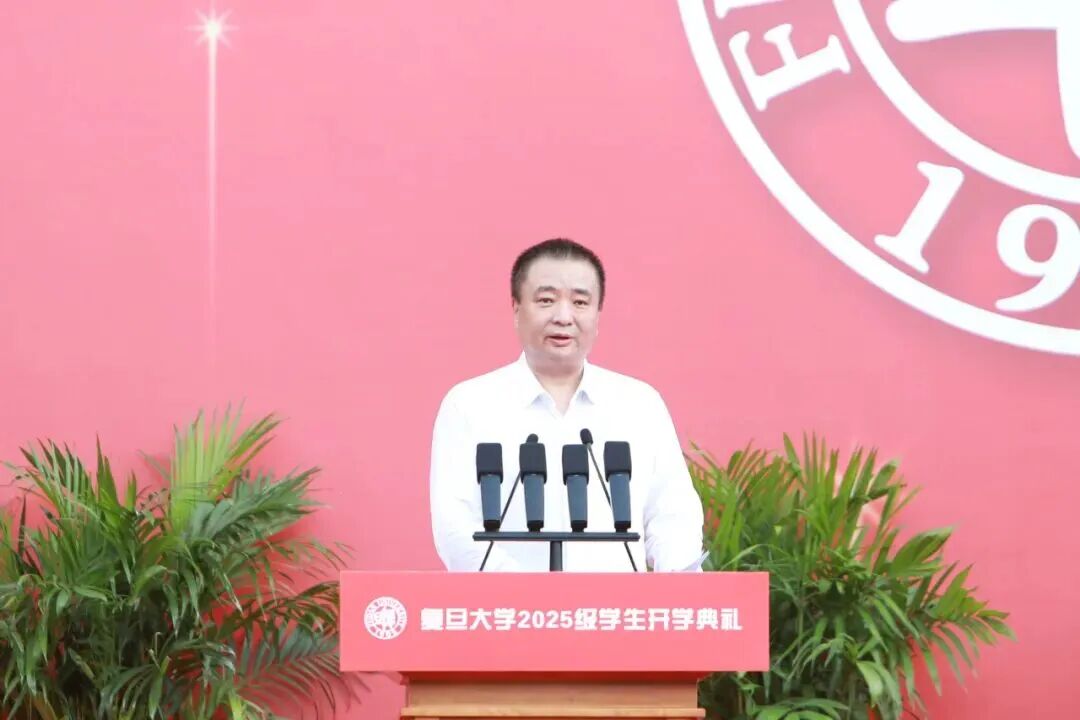
Learning to Make Choices and Achieve Self-development
- a speech given at the 2025 school opening ceremony of Fudan University
Yesterday, we honored our history and witnessed new strides in the unfolding journey of Chinese-style modernization. Today, we observed a new chapter of Fudan together. Dear fellow students, you are the first batch of students in Fudan’s third sixty-year cycle. This year, a total of 17192 undergraduates and postgraduates from 96 countries and regions are welcome into the big family of Fudan. Both the school and all of you are now standing at a new starting point. Hereby in representation of all Fudan members, I’d like to give sincere greetings and blessings to you, and earnest thanks to teachers accompanying and guiding us along the way!
A university is a “training ground” in life. And a man’s life is all about making choices. In terms of growth, choice-making is a particularly important ability, and one that needs constant tempering. We need to make choices constantly and thus make progress constantly. You have chosen Fudan, which is a critical choice in life; and after coming to Fudan, you will and have to face more choices. Only when you have learned to make choices can you learn to learn, learn to innovate, achieve self-development and create a bright future. Therefore, I’d like to take this opportunity to share with you some of my thoughts upon the topic of “learning to make choices”.
To learn to make choices, you need to continuously construct and update your knowledge structure.
You are the first batch of students after the comprehensive implementation of Fudan Education and Teaching Reform 3.0. With projectized enrollment and cultivation modes, “2+X+Y” overpass-style cultivation system, and the cultivation concepts of multidisciplinary, undergraduate-graduate, enrollment-education-employment and teaching-and-learning integration, an unprecedented number of opportunities for choices have been provided.
The core target of Reform 3.0 is to grant students the right and ability to independently construct their own knowledge structure, which is the cornerstone for us to deal with the complex and changing world, thus needs to advance with the times and renew through challenges. University life can lay out the basic framework of one’s knowledge structure, but it is more important to gain the competence of constructing and updating your knowledge structure independently.
The essence of learning is to build a bridge between the known and the unknown and keep expanding the cognitive boundaries during the process of constant choices and trial and error. Growing in a modern world, you have a much stronger consciousness of making your own choices compared to our generation, but when there is limited knowledge, experience and options, it is often difficult to make wise choices. For this, you need to develop a strong awareness of active learning and manage to learn more and understand more before making choices, so that you will have a wider range of options and thus can make appropriate choices.
Learning in university, you’ll find challenges everywhere, and so are choices. The two often go hand in hand, and sometimes catch you off guard. On this “training ground,” you might as well brave challenges more and allow for more trials and errors. Reform 3.0 has designed some multidisciplinary and overpass-style routes to different extents, from the macro level of switching between degree programs and combining interdisciplinary dual-degrees or micro-majors, to the micro level of choosing a P/NP option for a single course, aiming to ensure that you have ample opportunities for choices and sufficient room for trial and error.
I hope you will construct your own knowledge structure and continually broaden and integrate interdisciplinary knowledge, thinking and methods through tireless exploration, eventually developing a distinctive expertise and comprehend the ability and methodology to understand the world and to change it.
To learn to make choices, you need to break away from route reliance and find you passion.
If one still imagines university life as merely a good major preparing for a good job, he or she actually waives the right to choose and accepts “a defined life.” Coming to study at Fudan, you should aim not to prepare for your first job, but for “an undefined life”.
Some 30 years ago when I first entered Stanford University, there was a well-meant admonition for newcomers: You maybe somebody somewhere else, but you are nobody here. This tells us to adjust our mindset and learn to “start from 0.” At a high-level academic hall, choosing to “start from 0” doesn’t mean to blindly deny yourselves or deliberately maintain a low profile, but to be broad-minded with a global perspective and embrace an aspiring vision that “a blank canvas holds the greatest promise.” To truly “live a life that is a vast wilderness rather than a set track,” one have to first choose to break the past growth inertia and route dependence.
Fudan is a fertile land for students to grow. We sincerely wish more students can find their passion in life through their studies here. For the things, knowledge and people they like, youngsters need to make attempts bravely, daring to try and make mistakes while also having the courage to stand fast.
In this rapidly changing era, it is difficult to follow a perfect development plan based on existing “target-route” procedure. Instead, it’s necessary to regard life as a designing process with dynamic iteration. We anticipate that you will keep innovating your learning and campus life, and identify where your long-term true love lies through constant attempts and adjustments, ensuring a bright future for yourselves.
To learn to make choices, you need to make wiser choices and stick to them.
There are seldom perfect questions or answers in the world. Neither are optimal choices. The so-called good choices are all relatively, often neither so easy to make nor perfect. Learning to make choices means, on one hand, knowing when to let go, withstanding the temptation in front of us; and on the other knowing when to hold fast, willing to get devoted wholeheartedly in the long run.
Good choices demonstrate life wisdom. Whether you are an undergraduate or a postgraduate, never doubt your intelligence since you’ve made it to Fudan. Also, we hope you can grow wiser through your studies here. The wisdom of Fudan members is illustrated in their mental feature of “being extraordinary and interesting”, and is also reflected by the inner compass of “being free in spirit, yet useless in the utilitarian sense”. This summer, Secretary Xin Qiu and I visited many places, where many employing units affirmed that graduates from Fudan are “good to use”. Qiu expressed his voice from the heart by summarizing the four meanings of the “usefulness of the talents cultivated” by Fudan, which I think highly of and thus would like to share with you here:
First is being useless, of no utilitarian use. The “freedom” engraved in the heart of Fudan members refers to the freedom in both spirit and mind that promotes people’s comprehensive development, intelligence growth and fertility of mind; the state of “being useless” that Fudan members worship means “what seems uselss from a utilitarian perspective often serves the highest purpose”, and that people should not be constrained by the pursuit of immediate gains, but have the discipline to immerse themselves and the power to unleash a well of accumulated knowledge. Second is being useful, for the sake of social utility. Fudan’s students shall adapt to the needs of the development of the Party and the country's cause, as well as the needs of economic and social development. Third is being good to use, able to provide practical services. Graduates from Fudan have the ability to settle practical issues with a combination of competence, a positive attitude and strong skills to deliver solid work. Four is being of great use, qualified to shoulder the historic mission of national revival. As Fudan members, it is our duty to integrate personal endeavors into our shared, common cause, and grow into great talents able to change the face of China.
The aforementioned four types of “usefulness” cannot be reflected on separately, and they are not in a progressive relation either. By contrast, they reveal the philosophy, target and mode of Fudan’s talent cultivation from various dimensions, and carry our expectations for the growth of all the students at Fudan.
From today on, you will start composing your own stories at Fudan respectively. Looking forward to your being useless in the utilitarian sense, being useful,for the sake of social utility, being good to use and being of great use. In the future, you will learn to make choices and achieve self-development, striving to forge your own legends!





 86-21-63895588
 Handan Campus: Building B, No.579 Guoquan Road, Yangpu District, Shanghai 200010