Professor Huasheng Gao Publishes a New Book Following the Trend: Decoding the Logic of Political Finance in China - translating policy into a repeatable investment language | Heavyweight
Release time:2026-01-10
Recently, the new book entitled Following the Trend: Decoding the Logic of Political Finance in China, coauthored by Professor Huasheng Gao, Deputy Dean of Faculty and Research at FISF and Professor in Finance, and Yaheng Lin, a macro strategy analyst at a leading domestic fund management company, was published. The book traces the evolution of China’s political environment since the founding of the People’s Republic of China and explains the necessity of strengthening the unified leadership of the Communist Party of China.

Huasheng Gao
Deputy Dean of Faculty and Research at FISF
Professor in Finance
In contemporary China, the relationship between politics and economics has never been so intertwined. Fluctuations in the capital market, the evolution of the financial system, and shifts in policy orientation are often deeply embedded in the logic of national governance. If interpretation of the Chinese market is solely made with a single tool from traditional economics, it is often the case at many critical junctures that “phenomena are easy to see while the underlying causality is difficult to understand”. Therefore, in the new book, Huasheng Gao and Yaheng Lin attempt to translate the invisible yet decisive chain linking “politics, policy and the market” into an analytical framework that can be understood, internalized, and systematically replicated.
A core proposition is put forward in the book: politics determines policy, and policy shapes the market; market trends being both an embodiment of economic laws and an echo of political will. The authors summarize this perspective into a more systematic framework - “Political Finance with Chinese Characteristics”, wishing to provide investors and researchers with a cognitive framework that is more closely aligned with the Chinese context.
Readers can take away three “transferable” skills from this book. First, treat policy as “viable” instead of an emotion. Policy is not market noise; it is one of the core pricing factors in China’s market. Understanding political logic is a prerequisite for understanding how finance operates. Second, develop a method of “interpreting the meeting, the speaker, and the timing”. The same policy wording can carry different meanings in different meetings, different phases, and different combinations. The book dedicates a full chapter to “Major Meetings and Events” precisely to break down policy signals into an internalized skill set. Third, map the “policy chain” onto the “asset chain”. From industry to credit, from fiscal to monetary, from reform to sector-specific measures—each policy chain corresponds to a repricing of profits, valuations, and risk appetite. The second half of the book provides a coherent pathway from macroeconomics to specific sectors, and ultimately to market performance.
Due to publishing arrangements and other factors, the book is being launched initially by China Modern Publishing House (Hong Kong) as an online edition, with a print edition to follow as conditions allow.
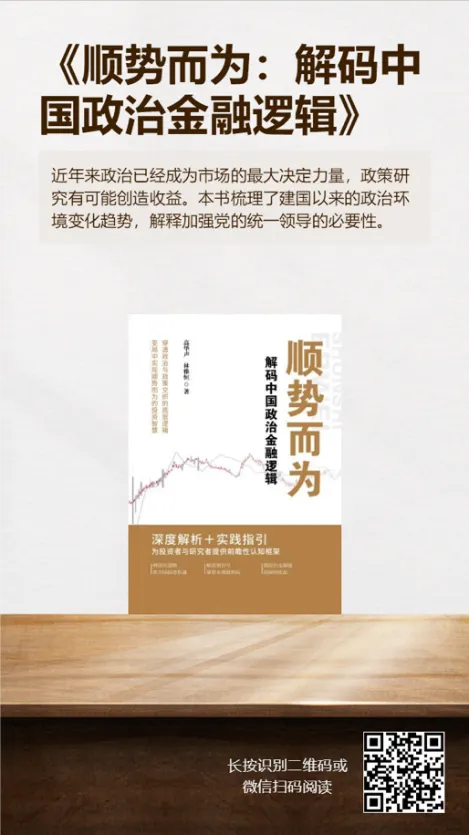
Following the Trend: Decoding the Logic of Political Finance in China
In recent years, politics has become the most decisive force in the market, and thus policy research has the potential to generate investment returns. This book traces the evolution of China’s political environment since the founding of the People’s Republic of China and explains the necessity of strengthening the unified leadership of the Communist Party of China.
scan QR code or scan via WeChat to read





 86-21-63895588
 Handan Campus: Building B, No.579 Guoquan Road, Yangpu District, Shanghai 200010