Marketing has never been a static discipline. As large models rewrite the logic of search, algorithms replace human creativity, and digital twins begin to expand the real world, practitioners’ understanding of reaching users is also being rewritten. On April 29th, an employee training course on Marketing Thinking in the AI Era was held. Featuring joint lectures by Jingming Lu, Director of the EMBA Program under our school’s EED (Executive Education Department), and on-campus EMBA students Qiuting Lu and Huidi Gu, the course offered an in-depth experience share.
Returning to the essence: five stages of marketing
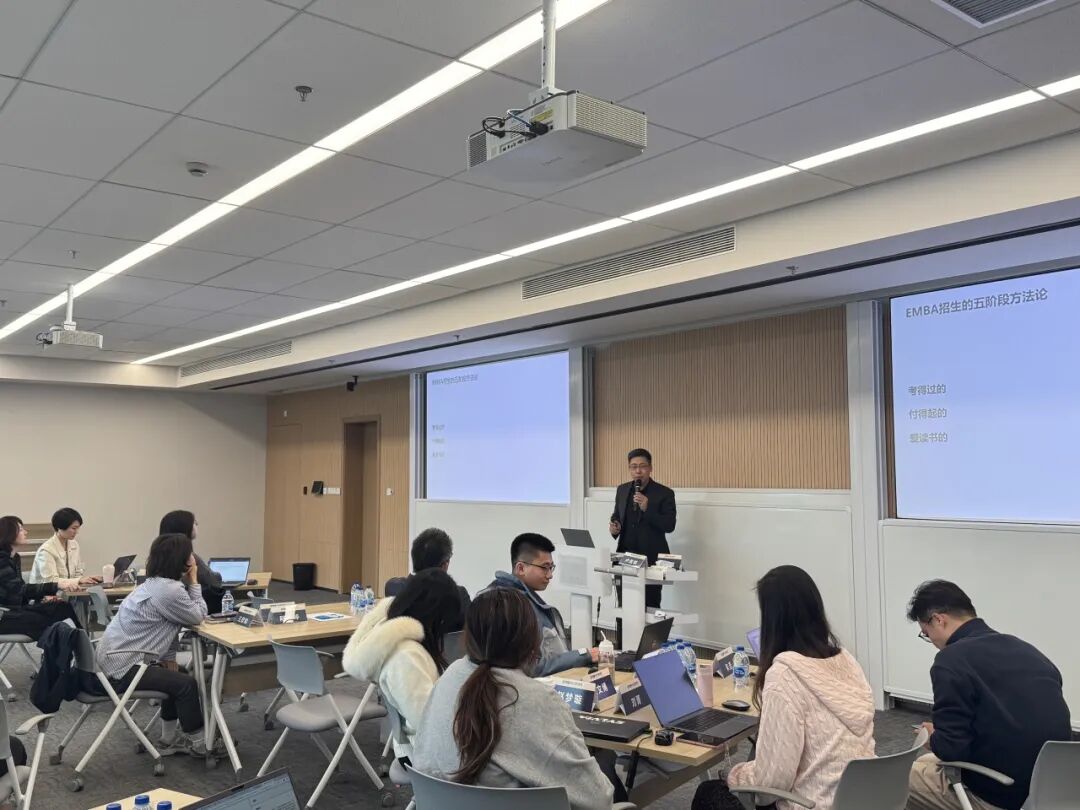
Taking EMBA admissions as his entry point, Jingming Lu shared the “five-stage marketing methodology” he has developed through years of practice. He broke down the complete admissions chain into five stages of pre-purchase, store visit, decision, first use, and sharing, pointing out that user demands differ vastly at each stage. “If any single link falls short, the entire chain will collapse.”
When speaking of where AI intersects with this methodology, Lu noted that currently AI delivers the greatest value at the “pre-purchase stage”, allowing prospective students to “see” the school right at the source of their information search through intelligent search optimization, user intent recognition, and authoritative content building. Drawing on data from mainstream AI platforms such as Doubao and DeepSeek, he vividly illustrated users’ psychological differences behind search terms and emphasized, “In the AI era, content is not about self-promotion; instead, it should speak through data, rankings and customer endorsements.” He encouraged people to break with conventional keyword thinking and to design content based on AI’s “lazy” logic, so that the transformation from “manual placement” to “intelligent reach” can truly be realized.
▆ FISF
Industry observations: AI is changing the underlying logic of advertising
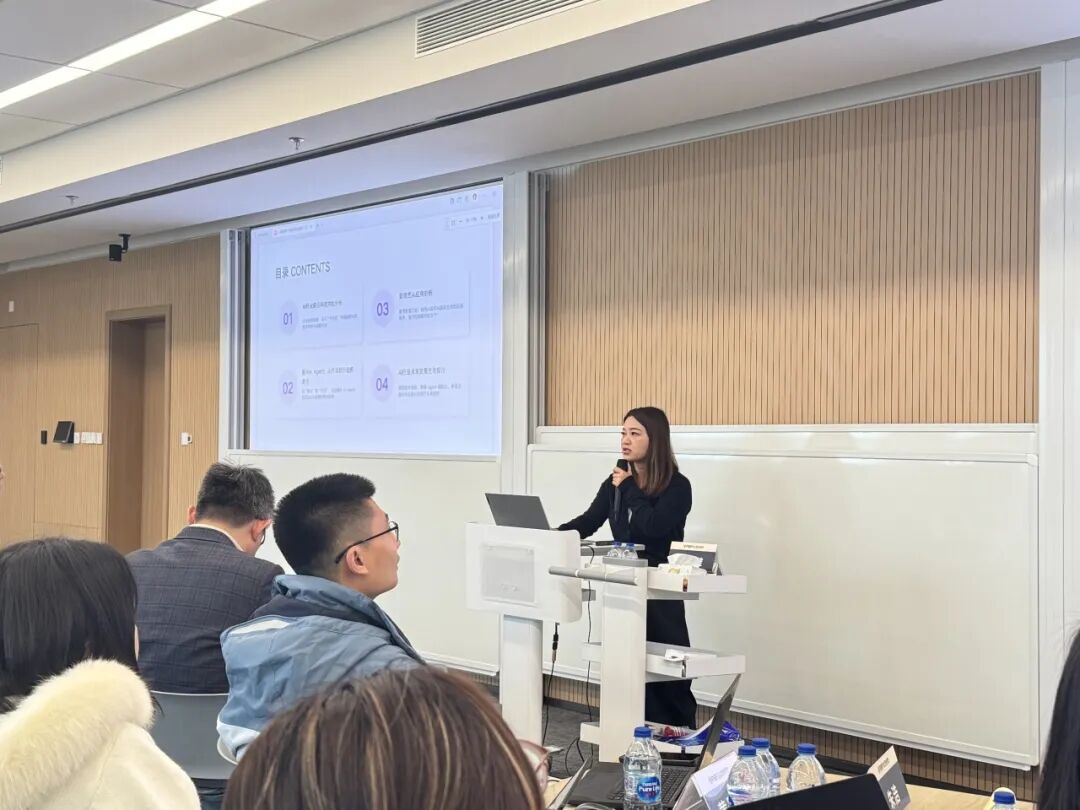
Qiuting Lu brought more specific industry observations from the frontline perspective of the advertising sector. She traced the evolution context from generative AI to AI agents, and focused on AI’s in-depth impact on advertising production and placement.
On the content production side, AI has drastically compressed the time and labor costs of material creation, enabling the rapid, large-scale generation of content that once required a full day collaboration of a copywriter and a designer. On the placement side, with the “one-to-one personalization” logic driven by algorithms and large models altogether, each advertisement that a user sees is exclusive content generated in real time.
Yet when it came to using AI agents, Lu did not shy away from the risks. She reminded people to watch out for instruction amnesia and data security issues. She recommended using cloud-based tools while retaining human confirmation at critical tasks. “We must embrace it, but we must also know how to harness it.”
▆ FISF
Tech frontier: extending from digital content to the real world
Huidi Gu’s sharing shifted the perspective toward a broader technological landscape. She analyzed the current pattern of AI development — if North America still holds the early-mover advantage in original breakthroughs from 0 to 1, then China has demonstrated an advantage difficult to replicate in industrial deployment from 1 to 100, particularly in fields such as smart manufacturing and embodied intelligence.
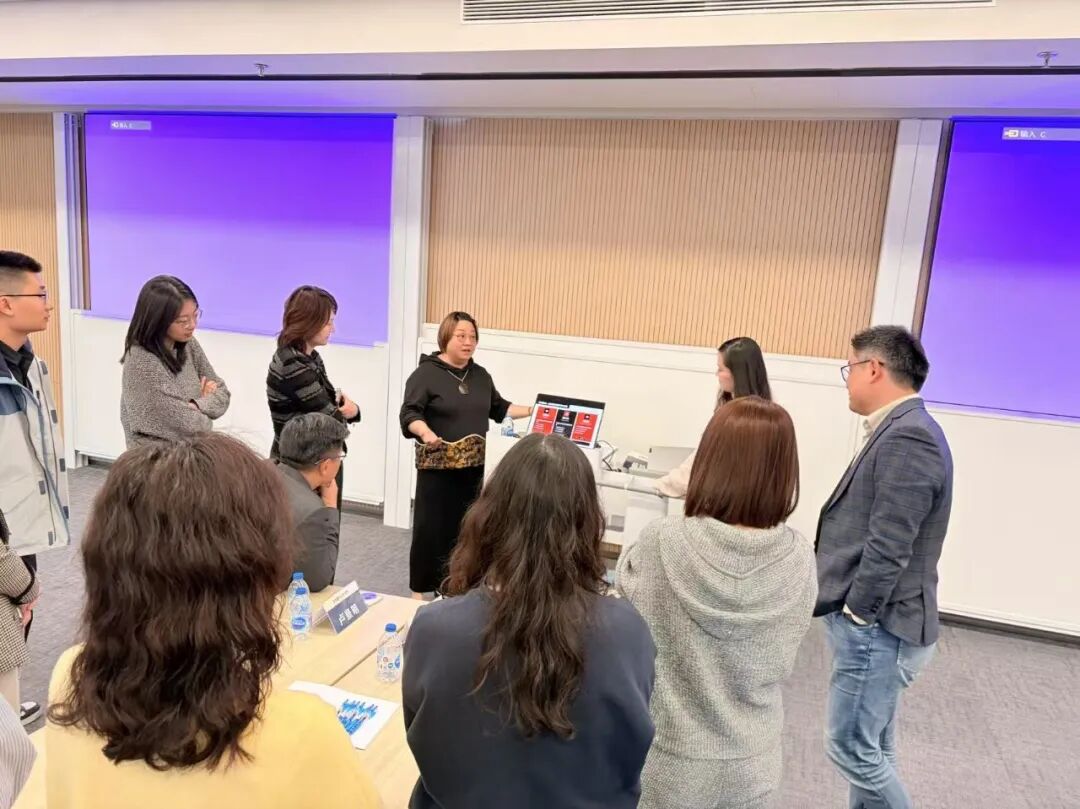
Gu mainly introduced the direction her team is currently pursuing: 3D reconstruction of real spaces based on Gaussian Splatting technology, empowering genuine interaction and exploration between the digital world and the physical world, rather than mere one-way content generation. By presenting a live demo of drones collecting data and generating a 3D spatial model in seconds, she provided the faculty and staff in attendance with a far more concrete sense of “AI deployment” than they had imagined.
“From content generation to task execution, and from digital space to the real world — this is how AI truly integrates with industry.” This judgment offered everyone present a new coordinate for understanding the future.
▆ FISF
The course was both intellectually elevated and grounded in real practice. Despite their different backgrounds and distinct angles to approach their topics, all the three speakers pointed to the same core proposition: AI is not a tool floating in the cloud, but a “super assistant” that can actually be embedded into marketing processes to improve decision-making efficiency.





 86-21-63895588
 Handan Campus: Building B, No.579 Guoquan Road, Yangpu District, Shanghai 200010