[A fleet of boats racing against the powerful tides] The Championship Team of 2025 Oliver Wyman Impact Case Competition Comes Out - From FISF | Career
Release time:2025-07-14
CONGRATULATIONS!
Recently the result of 2025 Oliver Wyman Case Competition was revealed. Team “Fintastic” from FISF won the championship! Congratulations to the four members - Shuangyu Wu, Luyao Chen, Qi Ying and Yiying Hu from EMF 2025! In the competition, they were able to face real business challenges and refine genuine knowledge on the top consulting stage, breaking themselves in team cooperation and exercising their professional skills.
The [A fleet of boats racing against the powerful tides] this time specially invited the champion team to share their wonderful experience and gains in the competition!
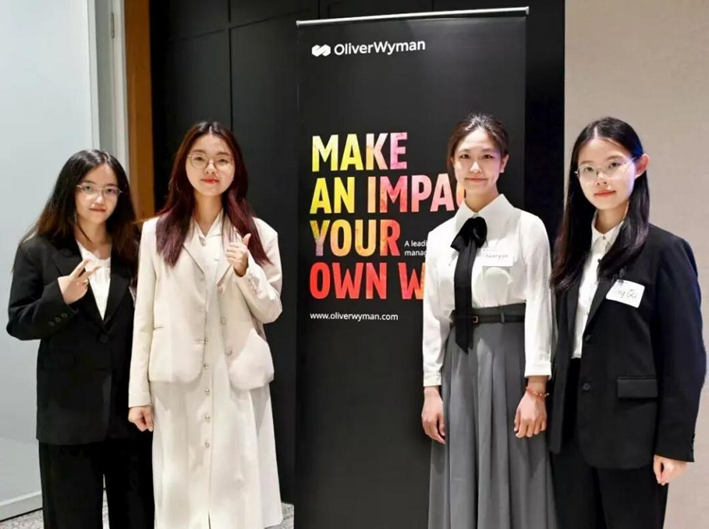
Congratulations to the four students in Team Fintastic!
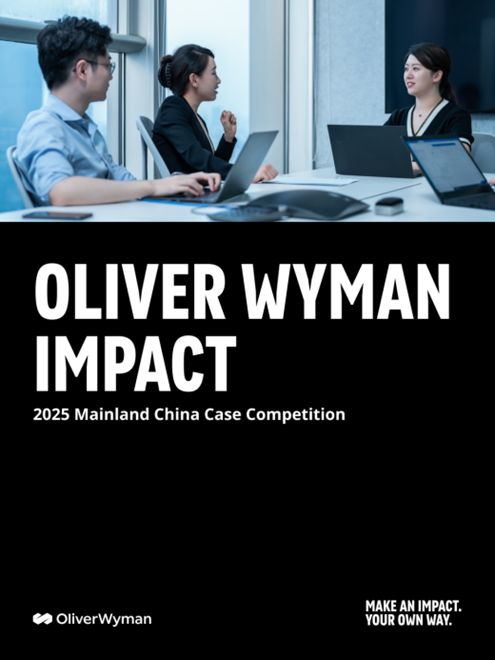
Oliver Wyman Impact
2025 Case Competition
The competition adopts the form of four-member teams, requiring competitors to settle specific problems of real business cases in simulation. The questions were provided by Oliver Wyman, usually adapted from true cases they had recently experienced.
Competing teams had about one month’s time to prepare, during which time they needed to complete market investigation, data analysis, and strategy formulation, as well as potential financial modeling and risk management, and eventually submit a solution report in the form of PPT. The competition process was: first submitting a report (in the preliminary/intermediary rounds), then selected teams with qualified report entering the on-site defense link (in the intermediary round).
During the whole process, full-time staff members of Oliver Wyman would provide guidance for competitors as consultants. Teams that ultimately made it to the finals would win the fast-track for Oliver Wyman’s campus recruitment interview.
From the initial mindset of just having a try to stepping onto the final stage, what Team Fintastic members repeatedly mentioned was self-accumulation to enhance their own research capabilities and methods. “We hope to learn from the competition process how to solve the pain points of an industry or a company by systematically formulating strategies and develop such analysis logic.”
The initial analysis thinking was to start from the pain points of an industry or a company and launch strategies from these two aspects. When further revising the scheme, the guiding mentor from Oliver Wyman offered a great deal of support, such as suggesting combing the entire industry and get the pain points throughout the strategy scheme instead of identifying pain points in a fragmented manner based on industry sectors. The members had come to understand the difference between the question-answering thinking as students and the problem-solving thinking as true professionals in career: unlike the traditional stereotyped thinking, the guiding mentor warned to highlight the brightest part of the scheme within just 20 minutes, which greatly affected the revised story line and helped a lot in the presentation in the final.
During the process of continually optimizing the scheme, we had learned more about the thoughts of the partner and the client: the essence of strategy formulation was being implemented actually and avoiding the situation that the scheme seemed feasible in any company or industry. It was necessary to integrate the pain points into analysis to make the scheme more down-to-earth, eventually forming a complete closed loop.
Key words of the final:
Improvisation and visualization tools
Overall integrity of the scheme and efficiency of information transmission
- The polishing of written materials was of great significance (which took us two months’ time), and we advise to invest more energy in predicting and simulating the tricky questions that might be raised by the judges, and making mental preparations to improvise at any time.
- For data presentation, it is suggested to explore and exploit a higher number of more efficient visualization tools to improve the expressiveness and professionalism of the scheme. This time we mainly relied on PPT, while encountering some challenges in applying Excel. When reviewing our performance in the competition, we found that some other excellent teams had managed to formulate more vivid and good-looking tables with tools like Tableau or Feishu Multi-dimensional Tables. So, we strongly recommend to use more suitable tools to enhance the visualized communication effect.
- The integrity of the team performance in defense shall also be paid more attention to. Members can interact more, and each one should make enough preparations for all the aspects of the scheme. Even though division of labor is needed for the sake of efficiency, team collaboration and integrity of the logical chain play an essential part when answering questions.
- As for PPT contents, we propose a pithier way of presentation to avoid issues like too many contents or key evidence not highlighted enough. The main PPT can be made more focused and efficient by taking auxiliary details and secondary evidence as backup, so that the judges can be quickly guided to get an understanding of the key points of the scheme.
From the perspective of the team leader:
I’ve deeply understood that a good teaming up is half the success. This requires much time to find reliable teammates who are complementary in capabilities or personalities and approving of the communication mode of the team, which is especially critical. In the process of teaming up, visualization skills and other relevant skills can be improved rapidly through learning while it’s difficult to cultivate the proper attitude of teammates and team collaboration. Therefore, finding appropriate teammates is truly important. This experience makes us fully aware of the key to team collaboration: adequate communication and respect for every thought of each other.
Such competitions are often easy to handle for FISF students, so I’ll just share some enhancing suggestions:
Firstly, PPT needs to be good-looking. Judges often determine whether you are qualified for the final based on the presentation effect upon first look. So, make sure to meet the basic requirement of PPT User-friendly (which I believe most of us can make it).
Secondly, in the Q&A session in the intermediary round, the judges paid special attention to the purposes and reasons of the subject selected. They would dig deep from the origin and ask, “Why do you choose to analyze this target?” And they would also examine whether the research and analysis of details were solid and whether they could effectively support the final strategy.
Thirdly, it is extremely important to display a decent on-site performance in the final. For example, the “Best Presenter” award was granted to a junior student (female) who stood on the stage with exceptional ease, which was just the feature the judges valued. On the contrary, we might appear a bit nervous.
In the early stage we had tucked in too many contents, and had to make substantial cuts later, wasting time to a certain degree. In reflection, we would pay more attention to adjusting the framework dynamically during the process, strengthen the logic link among different parts, and delete contents irrelevant to the core storyline if there are other chances for us to do similar cases. Besides, the case itself is highly extensible, providing vast space for imagination while also posing higher demands upon us: on one hand, when identifying the user’s pain points and formulating strategies, we must learn to prioritize the big picture over the details in order to ensure the scheme is well-founded; and on the other hand, there needs to be more discussions and communications in the team, and the boldness to repeatedly overturn old ways of thinking.
Enjoying the process:
Originally our team did not set too high of expectations. Instead, we all upheld the idea that “participation is what matters.” only expecting this experience to add impressive points to our resumes and improve our capabilities. This rid us of excessive anxiety about the result throughout the entire process. Even when we were standing on the spot in the final, we encouraged each other that “it was good enough for us to get here.” and thus we were able to complete the competition with a calm mindset, willing to accept any result. Looking back on this experience, the process itself, where we worked hard, figure out brain burners and break through ourselves together with teammates, is a precious reward. In consequence, we advise junior students or other competitors in the future that you should first reset your mindset and keep positive. If you hold this kind of mindset, you can have a great experience and performance whatever competitions you are in!
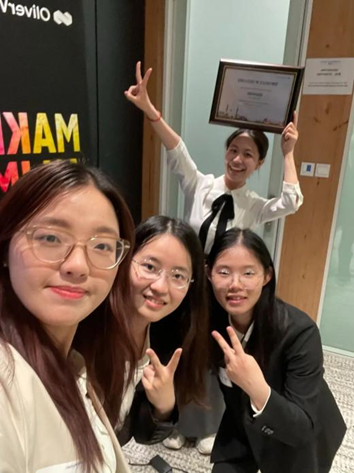
Easter egg
“We’ve never been more serious in giving our team a good name. We even thought of several names with AI, and in the end the team leader decided upon the name “Fintastic”, which was easy to write when filling information; and could give us a boost as it represented the combination of “Finance” and “Fantastic.”
The competition process of Team Fintastic vividly revealed a truth of growth, “a happy kind of tiredness”. The close collaboration and idea exchange in the two months has not only enhanced their business analysis and problem-solving capabilities, but more importantly, they have acquired a profound team bond and a sense of satisfaction in making self-breakthroughs. The valuable experience of going from “just having a try” to making it to the final stage is far more than a minor highlight. FISF and PDC cheer for them and expect more students to seize the opportunities of actual combats and build up their own future competitiveness in competitions.





 86-21-63895588
 Handan Campus: Building B, No.579 Guoquan Road, Yangpu District, Shanghai 200010