Professor Jun Qian Accepts an Interview of Shanghai Securities News, Offering Policy Advice on Building Shanghai into the Financial “Anchoring Ground” for Chinese Enterprises Going Global | “Two Sessions” FISF Voices
Release time:2026-02-10

“Two Sessions” FISF Voices
On the morning of February 2nd 2026, the Fourth Session of the 14th Shanghai Municipal Committee of the Chinese People’s Political Consultative Conference (CPPCC) opened at the Expo Center. On the morning of February 3rd, the Fourth Session of the 16th Shanghai Municipal People’s Congress was held at the Expo Center.
Drawing on their industry observations, social research, and public input, the delegates have formulated this year’s policy proposals across a wide range of fields—from financial technology innovation, cultural tourism and consumption, and urban renewal, to education and employment, as well as elderly care and childcare services.
During the “Two Sessions”, Jun Qian, Member of the Shanghai Municipal Political Consultative Conference, Executive Dean of FISF and Professor in Finance, accepted an interview of Shanghai Securities News, offering policy advice on building Shanghai into the financial “anchoring ground” for Chinese enterprises going global.
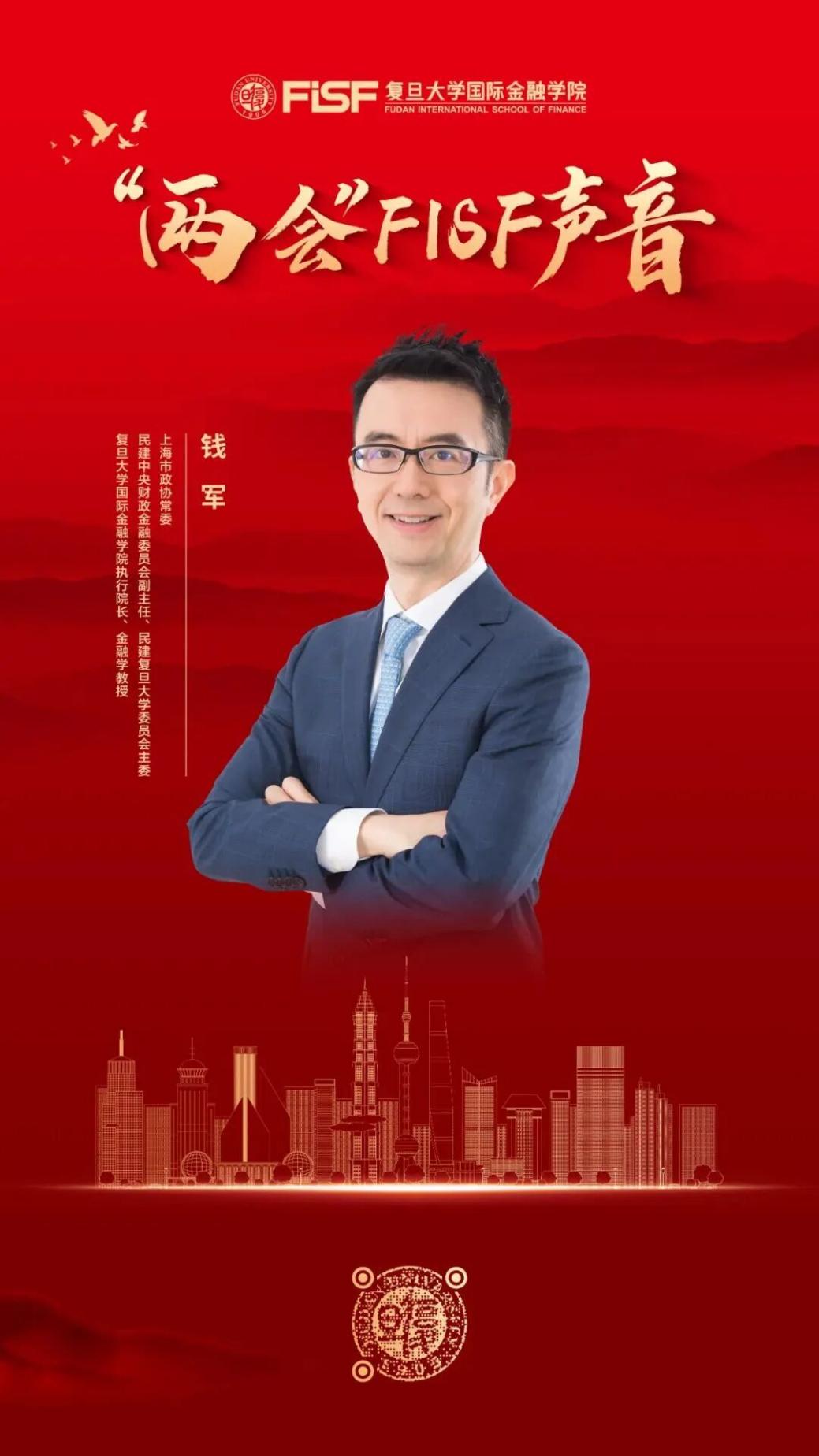
“Two Sessions” FISF Voices
Jun Qian
Member of the Shanghai Municipal Political Consultative Conference
Vice Chairman of the Central Financial and Economic Affairs Committee of the CNDCA, Chairman of the Fudan University Committee of the CNDCA
Executive Dean of FISF and Professor in Finance
Accelerating the construction of the RMB-denominated financial assets allocation center
In his interview with Shanghai Securities News during the “Two Sessions”, Jun Qian stated that a key direction for lifting Shanghai’s status as an international financial center is to raise the internationalization level of its “traditional sectors” such as the stock market, bond market and commodity market. Among them, internationalization of the bond market particularly holds immense potential. As the economy grows, domestic enterprises will increasingly “go global”, expanding into global markets and integrating into local markets. With the assistance of domestic securities firms also “going global”, they are expected to issue RMB-denominated bonds. In this sense, Shanghai is well-positioned, and should become the “anchoring ground” and home base for comprehensive financial services supporting Chinese enterprises “going global”.
Gui Chen, Member of the Shanghai Municipal Political Consultative Conference, President of the International Business Chapter of the Shanghai Overseas Returned Scholars Association and Partner of Shanghai Anjie Law Firm, told Shanghai Securities News that offshore credit and offshore bonds are core business segments of an international financial center, and also the crucial pillars and key drivers for promoting RMB internationalization and enhancing Shanghai’s capacity to allocate global financial resources. He suggested accelerating the innovation and development of the offshore credit business to help Shanghai become a global offshore RMB credit hub. He also recommended further refining and improving relevant measures within the existing institutional framework to build an offshore bond market characterized by unified rules, efficient operation, manageable risks and global influence.
Regarding institutional construction, Chen proposed that Shanghai should take the implementation of the Several Provisions of Pudong New Area of Shanghai Municipality on the Development of Free Trade Zone Offshore Bond Business as an opportunity to push forward the establishment of “a special rule system for offshore finance”; advance the introduction of the “Shanghai International Financial Center Offshore Finance Regulations” to include the issuance, registration, custody, clearing, settlement, information disclosure and other core aspects of free trade offshore bonds into a legal framework; and set up an “Offshore Financial Court” in Pudong New Area as well as a specialized offshore finance adjudication division within the Shanghai Financial Court for the purpose of centrally governing foreign-related offshore bond disputes and thereby providing a stable legal expectation for domestic and overseas market participants.
He further put forward that Shanghai could pilot a “digital perimeter” regulatory model: drawing on the experience of “Asian Currency Unit” (ACU) account segregation in Singapore, upgrade the functions of Shanghai Free Trade (FT) Account and explore the establishment of a “New Offshore Account” (NOA) system.

Create a pivotal hub for Chinese enterprises “going global”
During the “14th Five-Year Plan” period, a major source of vitality for Shanghai International Trade Center has been offshore trade. Shanghai Securities News learned from the Pudong New Area Commerce Commission that in 2025, the offshore trade volume in Pudong New Area reached USD 103.471 billion dollars, exceeding the $100 billion mark for the first time and accounting for 95.14% of the total volume in Shanghai. Based on the starting point of 42.477 billion dollars in 2022, the average annual growth rate of offshore trade volume in Pudong during the “14th Five-Year Plan” period was approximately 20%.
Offshore trade is not only an innovation in trade models, but also a pivotal hub for enterprises “going global”. “Shanghai possesses the fundamental factor endowments to build a ‘home port’ for Chinese enterprises going global. However, the key lies in converting these factor advantages into stable, replicable public service capabilities,” said Rongming Wang, Deputy to the Shanghai Municipal People’s Congress, Member of its Financial and Economic Committee and President of Shanghai University of International Business and Economics, in an interview with Shanghai Securities News.
Wang advised that Shanghai should enhance top-level design and centralize operations to form “one standard, one foundational data platform and one coordinated chain”. He called for accelerated formulation of Shanghai’s “Going Global” platform construction and service standards, service precision improvement guided by “scenario-based solutions”, cross-border financial toolkit perfection, supply expansion of cross-border RMB credit, and optimization of the use of instruments like the FT Account. Moreover, it is also necessary to refine supporting policies to address pain points in offshore trade financing and settlement while developing small-currency settlement and risk management tools to improve settlement convenience and risk hedging capabilities.
Content source: Shanghai Securities News
Written by: Weiping Song, Ximeng Yan





 86-21-63895588
 Handan Campus: Building B, No.579 Guoquan Road, Yangpu District, Shanghai 200010