Professor Shang-Jin Wei’s Article Published in Caixin Weekly Column: Assessing the Impact of U.S. Tariff Rulings | Info
Release time:2026-03-05

The ruling may alter the legal provisions on which U.S. trade policy is based, but it is unlikely to lower the overall height of U.S. trade barriers. Instead, the United States will restore tariff rates finding other means.
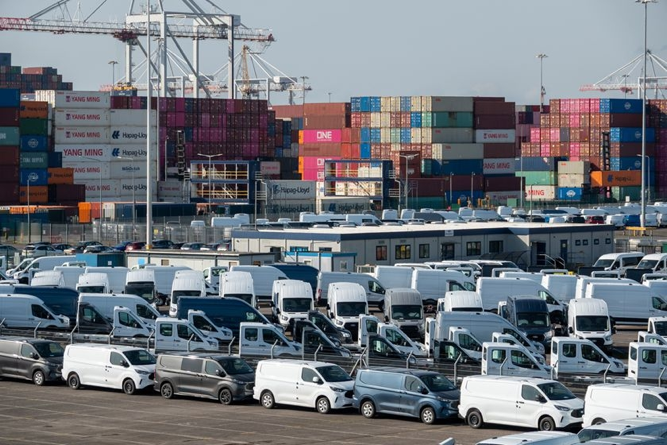
On February 25th 2026 local time, trucks were parked at the port in Southampton, UK. The image was taken after the U.S. Supreme Court blocked multiple applications of Trump’s comprehensive import tax plans. (Photo: China Visual)

Shang-Jin Wei
Fudan International School of Finance
Academic Visiting Professor in Finance and Economics
Tenured Chair Professor at Columbia University
On February 20th (EST), the U.S. Supreme Court announced its ruling on the Trump tariff case, determining that the International Emergency Economic Powers Act (IEEPA), which the Trump administration had invoked to impose “reciprocal tariffs” globally and additional tariffs on specific countries, does not, as a matter of law, authorize the U.S. President to levy tariffs. The ruling quickly made headlines and drew strong condemnation from Trump himself. However, its economic impact on other countries and global trade is likely limited.
The IEEPA-based tariffs may have already violated the most-favored-nation (MFN) principle of the World Trade Organization (WTO). But Trump has since imposed a 10% tariff on global goods under another law—Section 122 of the Trade Act of 1974—and has threatened to raise it to the maximum 15% permitted.
In the short term, the impact of this new tariff varies significantly across countries. Before the Supreme Court ruling, the U.S. weighted average effective tariff rates applied to various countries were approximately as follows: China 36.8%, India 22.3%, Vietnam 21.6%, Indonesia 23.5%, Thailand 19.4%, Japan 14.9%, South Korea 12.8%, Malaysia 11.6%, and Singapore 6.7%.
And now, after the new 10% across-the-board tariff imposed under Section 122 of the Trade Act of 1974, the effective tariff rate on Chinese exports to the United States has now fallen to approximately 26.9%, India to 13.9%, Vietnam to 16%, Indonesia to 16.4%, and Thailand to 14.8%. Tariff rates for Japan and South Korea have risen slightly, reaching 13.5% and 12% respectively. The European Union and the United Kingdom will also find themselves in a worse position than before the ruling, as they have already made concessions to the United States in bilateral negotiations, only to result in the U.S. concessions smaller than the “reciprocal tariffs” that have now been eliminated. Nevertheless, U.S. Trade Representative Greer has stated that the United States will determine tariff levels for each country through other means. The winners and losers created by the Supreme Court ruling may therefore be temporary.
The Trump Administration has initiated procedures to invoke Section 232 of the Trade Act of 1974, which concerns national security, and Section 301 of the same act, which addresses unfair trade practices, in an effort to restore the previous tariff landscape. Of the two, Section 232 authorizes the U.S. Department of Commerce, after an investigation, to impose tariffs on specific products—for example, a 25% tariff on steel; while Section 301, on the other hand, empowers the Office of the U.S. Trade Representative (USTR) to impose retaliatory tariffs on specific countries after investigation. Such investigations typically allow for considerable discretion, so in theory, Trump could draw upon these provisions and reinstate all country-specific tariffs that were in place before the Supreme Court ruling.
As early as his first term, Trump already used “Section 301 investigations” to impose high tariffs on certain Chinese imports. The Biden administration, in its subsequent reviews, determined that some of China’s unfair trade practices persisted and thus extended Trump-era tariffs. Trump can directly invoke the review conclusions of the Biden administration as a basis for imposing new tariffs. Moreover, the new tariff rates could be higher than the levels previously set under IEEPA.
In principle, other countries could follow the EU by initiating litigation against the U.S. under the WTO dispute settlement mechanism for its unfair use of Sections 232 and 301 of the Trade Act of 1974.
However, ever since 2019, the U.S has consistently blocked the appointment procedure for the new judges to the WTO Appellate Body, which was paralyzed due to the number of its judges remaining below the minimum required to function. In 2020, the WTO dispute settlement mechanism ruled that the Section 301 tariffs imposed by the Trump administration during his first term lacked proper justification; but failed to become a binding final decision due to the incapability to function of the Appellate Body.
Compared with other countries, the U.S. has two distinct strategic advantages: the ability to weaponize commerce and the ability to commercialize weaponry. The U.S. government can take advantage of its position as the world’s largest import market to pressure other countries into making concessions; while also “inducing” them to make compromises in investment and trade by exploiting the reliance of its allies on the U.S. for security.
Trump’s willingness to employ both tools makes other governments deeply hesitant to take the U.S. to the WTO. For Japan, South Korea, and some European countries, security considerations are likely to outweigh any benefits that litigation might bring. Whether the WTO dispute settlement mechanism can resolve these issues legally is one question; and whether these countries are politically willing to resort to it is quite another.
Eventually, the Supreme Court’s ruling on Trump’s tariffs may alter the legal provisions on which U.S. trade policy is based and could lead to a temporary surge in imports. However, it is unlikely to lower the overall height of U.S. trade barriers or significantly change the pattern of how those barriers are distributed across different countries.
Content source: Caixin Weekly, Issue No.08, March 2nd 2026





 86-21-63895588
 Handan Campus: Building B, No.579 Guoquan Road, Yangpu District, Shanghai 200010